First Visual Prosthesis Implant in a Blind Domestic Cat
Neuralink for Visual Prosthesis: If you're interested in participating in our future clinical trials for visual prosthesis, join our Patient Registry.
Preclinical Progress
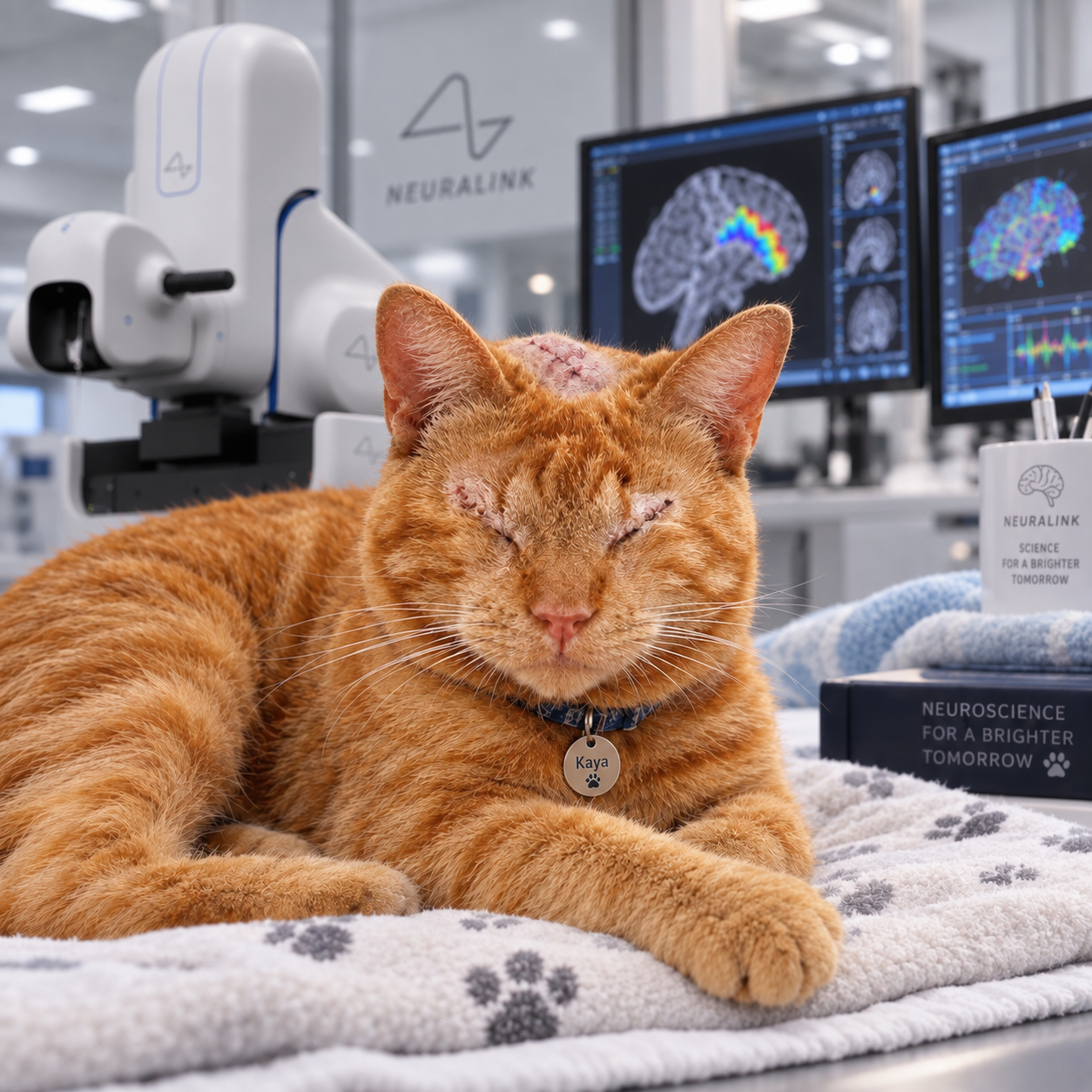
Subject: Kaya (Feline Domestic Shorthair)
Study Overview
We have successfully implanted our specialized visual prosthesis interface in a blind domestic cat named Kaya, the first feline subject to receive Blindsight-related technology in a preclinical setting.
Surgical Placement & Methodology
Kaya, a three-year-old domestic shorthair who lost vision due to bilateral ocular conditions that left her optic pathways non-functional, received the fully wireless implant via our precision surgical robotics platform. Ultra-thin flexible electrode threads were placed into regions of the visual cortex.
The system bypasses damaged eyes and optic nerves. A video camera captures the surrounding environment, processes the images, and wirelessly delivers patterned stimulation to generate artificial visual percepts.
Early Findings & Recovery
Early recordings show detectable neural responses consistent with stimulation of visual areas. Researchers are monitoring behavioral indicators, including orientation toward visual stimuli presented via the camera feed.
Kaya recovered well, is active and mobile, and is adapting to the investigational system under continuous veterinary care.
This carefully controlled exploratory study expands our understanding of high-bandwidth interfaces in the visual system across mammalian models and advances the science behind Blindsight.
Upcoming Human Programs
Our primary human programs remain focused on restoring independence for people with paralysis through motor studies and related trials, as well as speech decoding initiatives. The visual prosthesis program continues as an upcoming translational opportunity.
Join our Patient Registry to be informed when we launch trials in the United States for visual prosthesis.
If you or someone you love is interested in learning more about Neuralink’s clinical trials, we encourage you to join our Patient Registry.
How it works
During normal vision, the retina converts incoming photons into electrical signals that travel via the optic nerve to the primary visual cortex at the rear of the brain, creating visual perception.
When ocular structures or optic nerves are permanently damaged, natural signal conduction ceases, leading to blindness even when the visual cortex remains intact.
Neuralink's visual prosthesis bridges this gap by directly stimulating visual cortex neurons. An external optical sensor captures environmental imagery, translates it into real-time stimulation coordinates, and wirelessly delivers micro-pulses via high-density cortical electrodes to induce phosphenes and reconstruct visual form.